OFFER: A BRAND NEW SERIES AND 2 FREEBIES FOR YOU!
Grab my new series, "Whispers of Regency Love", and get 2 FREE novels as a gift! Have a look here!
Chapter One
The mist off of Loch Leven clung to the narrow streets of Glencoe like a blanket as Lady Margaret Whitcombe claimed a spot on an upturned log, amid the harmless bustle of market day. She had dressed to disappear, with a simple frock and a heavy wool shawl crisscrossed over her chest and tied firmly in the back. Her brown hair, thick and wavy when left to its own devices, was braided back and hidden beneath a wide-brimmed bonnet.
A few locals would know her, if they got a view of her face, but if she kept her head tilted down she would be left to the sweet solitude of a crowd of strangers—allowed to scribble away at the sketchbook balanced on her knees.
Today, the subject of her art was the rough stone wall behind the butcher stall, covered in ivy and barely concealing the bulk of highland mountains rearing like a dark shadow over its peak. Below the wall, already taking shape on her paper, she intended to sketch in a few figures from market, although she had not yet decided which. Perhaps one of those children, tussling with a ball in the square; perhaps the rotund butcher hanging the carcasses of small animals along the edge of his stall; perhaps the pair of lovers who leaned against a distant bench, whispering sweet nothings into each other’s ears.
Her chosen spot—full of noise and busy laughter—was a refuge…as long as no one noticed who she was. The moment she was recognized, “Maggie” would disappear and the grieving fiancée would be in her place. It had happened just a few days ago, at the latest of her mother’s matrimonial schemes, when her mother had determined a ladies’ luncheon was the appropriate time to loudly discuss the proper length of time for grieving a loss.
Maggie sketched furiously, remembering the scene as though it was unfolding in the mist before her.
“Six months, isn’t it?” her mother had asked Great Aunt Matilda, loud enough that the drawing room of simpering ladies turned their attention upon her and a miserable Maggie. “Six months is a perfectly appropriate time for a young lady like Margaret to be in mourning. It’s not as though she knew the man very well, after all—they largely met and continued their relationship through correspondence. Yes, I believe six months is long enough for my dear girl to be in mourning.”
Here she’d paused to smile pointedly at Maggie, who was sitting near at hand in a black muslin dress buttoned up to her neck, her cheeks burning, her embroidery needle working furiously in and out of a patch of muslin.
Maggie had felt the attention of the other guests settle on her with interest. She knew when she’d first arrived, more than a year ago, to take over her uncle’s estate, the highlands had been full of gossip about who this single lady from England was. She was certain her mother and father, Lord and Lady Whitcombe, would not have dreamed of allowing her to travel to Scotland alone if it wasn’t for Great Aunt Matilda, whose husband’s abrupt death had been the cause of Maggie’s good fortune in the first place.
He, in the absence of any children and in the face of a rare, unentailed castle and surrounding lands, had done a rather shocking thing in London society—entailing the entirety of his assets over to his only niece, providing she cared for his beloved wife until the day of her passing. And that is how Maggie, now five and twenty years of age and in possession of a large amount of personal property, found herself one of the most desired prospects in the area and yet somehow still single and free.
That…and Major Alasdair MacLeod. He’d helped considerably.
Maggie smiled as she remembered Great Aunt Matilda’s response to her mother’s prodding. At least that was one silver lining on a humiliating day. The old woman, arrayed in more lace than could possibly be becoming, and peering out of rheumy eyes on Lady Whitcombe, intoned, “My dear, it is always such a gift to have you present at the castle, especially when you take such a keen interest in your daughter’s affairs. When, pray tell, will we be denied your sweet spirit in these hallowed halls?”
Maggie had been forced to cover her giggle with a coughing fit to avoid angering her mother further. Lady Whitcombe and Lord Whitcombe had travelled from London on more than one occasion since Maggie’s assumption of the property. They came under the guise of affection, but Maggie knew they were checking to be certain she was not growing into a wild thing. They suspected Great Aunt Matilda was not teaching etiquette and house management as she ought…and in truth, they were not far from the truth.
Great Aunt Matilda, though devoted to teaching Maggie how to properly care for the house, seemed less concerned with which spoon to use in a dinner party and more concerned with Maggie’s independence and capability. She put on airs, whenever Maggie’s parents visited, and hosted parties, but when left to themselves, Maggie and her great aunt had a quiet life characterized by freedom, fireside chats, and mountain roaming.
At least, Maggie roamed. Matilda was many things, but “spry” no longer made the top of the list.
“Hot bannocks, miss?” A boy popped into view, interrupting her reverie, a basket of warm bread in his arms. “Half price today, mum says.”
Maggie paid him a few coins and took one of the loaves, biting gratefully into the steaming soft bread, hot from the griddle. The warmth of it fought off the mist better than sunshine. Her mind may have been active, but her fingers had kept up busily in the absence of her intellect. The sheet was now covered with a sketch of the wall and the mountains beyond, and a brief outline of a child chasing a ball was taking shape at the base of it all.
Maggie stood, stretching her stiff limbs, and tucked the sketchbook back into her bag, wandering over to the baker’s stand with the bannock still in hand.
“Ah,” the baker’s wife grinned, pushing a lock of thick red hair out of her face and setting out some stiff sourdough loaves, “I wondered if that was you, lassie—” she stumbled a bit and added, “my lady.”
Maggie pretended not to hear the slip-up. It was decades now that the English had held firm hold on the Scottish Highlands, but that didn’t change all the history that came before. Matilda told her this very village had been the sight of a massacre more than one hundred years before, when the English had slaughtered the entire MacDonald clan because of what later was determined to be a simple geographical mix-up on the part of their chief. She knew pain in these parts ran deep, and she was not about to correct the sweet woman before her for a pleasantry not built into the fabric of this nation.
“Your boy says the bannocks are half-price today,” she said, raising one as evidence, “but I suspect otherwise. Are you discounting for me, Mrs. Ferguson?”
Mrs. Ferguson snorted. “And lose the chance to make coin off of you, my lady? Never. No, they’re cheaper because they’re a day old,” she lowered her voice, “and I’ve but warmed them over the fire this morning, with a bit of fresh butter.”
Maggie laughed aloud. “Your honesty does you credit. May you wrap two of these loaves over here up for me? We have guests in town.”
“Your cook will have my hide,” the baker’s wife winced. “She makes a fine loaf herself.”
“She’s the one that commissioned me to pick these up,” Maggie assured her. “I think it’s a relief, every now and again, not to have to make your own bread for a house as large as ours.”
Something shifted in Mrs. Ferguson’s face—something Maggie recognized and wanted to avoid. Before she could make an excuse to leave, however, the older woman reached out and laid a calloused hand on her arm. “My lady, I hope you don’t mind me asking—how are you doing? Word on the street is…it’s been six months now…”
Maggie resisted the urge to pull away. The woman standing across from her meant well. “I am quite resolved to the tragedy now, I think. I appreciate the respect you and the other villagers gave me when the news first came out.”
“It is a sad thing, to have a lad lost at sea,” Mrs. Ferguson said, shaking her head wisely. “No closure to speak of, and the hurt goes on hurting long after others have forgotten.” She eyed Maggie’s rough brown dress. “I see you’re out of mourning.”
“Barely, and only because my mother insists.” Maggie ran her hands nervously along her skirts. She missed the black gown. At first, it had drawn far too much attention, but as people grew used to seeing her in mourning it had the opposite affect—vanishing her from the public eye for a time.
A single woman of means was of no interest to society as long as she was in mourning. There was no way for a gentleman to court her or a meddling mother to make a match. No, she’d enjoyed six months of peace because of her mourning, and even more before that, because of dear Major Alasdair MacLeod and his impossible engagement.
Maggie tucked the loaves into her bag, bade the baker’s wife farewell, and made her way along the path out of town, smiling to herself at the thought of Major MacLeod and all he’d meant to her. It was good while it lasted, she thought wryly. And all good things must come to an end.
The major had indeed been a good thing—a completely invented, absolutely false, good thing, but a good thing, nonetheless. When Maggie first found herself facing the London ton in all its grandeur, she’d been frozen by the possibility that her mother’s conniving ways would have her married off to some gnarled count by the end of the year. She wasn’t ready to lose her freedom—not yet.
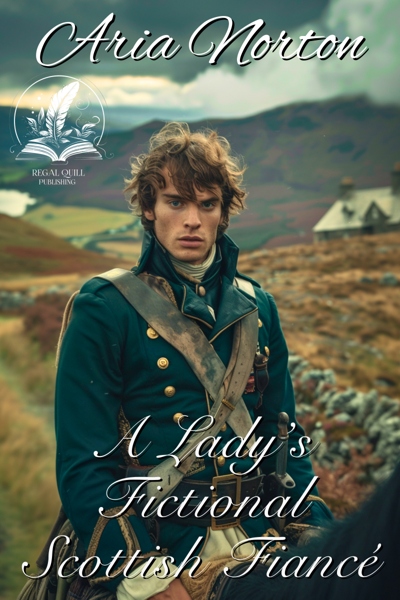
One day, shortly before the first ball of the season, nineteen-year-old Maggie had caught sight of a name in the casualty lists from one of her father’s old newspapers. Major Alasdair MacLeod, 42nd Highland Regiment. Poor soul. She wondered briefly who he was and thought how very handsome and sophisticated his title seemed.
Handsome and sophisticated. Precisely the sort of gentleman a girl of her standing could be expected to marry, and what a wonderful sensible fellow he was: a man so far away he could only be reached by writing. A man she alone knew was not just a figment of her imagination, but a figment that would never be in danger of resurrecting to haunt her since he was, as proved here, a casualty of war.
That was the seed of Maggie’s elaborate deception. By the end of the month she had a solid system, writing to her dear Alasdair in the military office, but applying a false and fabricated return address for the inevitable moment when the military office would be forced to send the letters back because of MacLeod’s untimely death. The false address went to one of her uncle’s Edinburgh connections, a warehouse of sorts where the return letters went to disappear.
There was the problem of return letters—that took a bit more cunning, to be sure. Maggie wrote them herself, dropping them into the post at various spots throughout London. It got to be a bit of a game. Once, she even mailed herself a letter from the milliner’s, where she had come to purchase a hat. Nobody was the wiser.
Her mother and father were displeased with the idea of a Scottish Major as their daughter’s fiancé, primarily because he never materialized to marry her officially. Extended engagements had their merits, but Lord and Lady Whitcombe wanted grandchildren and the society benefits of seeing their daughter merrily tucked away in some hamlet or other. Instead, they simply got an independent woman with a gentleman who, though he corresponded with the admiral regularity, never materialized.
Maggie was just beginning to panic about next steps—should she hire a gentleman to pose as Alasdair for a time?—when she received news of her inheritance and her future in Scotland. It was the answer to all her problems. She no longer needed to have a fiancé, not if she had her own means and property. She moved to Scotland, waited a few months, and then promptly killed Major Alasdair MacLeod off.
He died in battle, a hero. She felt she could hardly have done any better than that and hoped his ghost wouldn’t come haunt her for dragging his name through so much intrigue over the last few years. Now she faced the sympathies of the highlands, and, she knew, she would eventually face suitors. She was bracing for the uncomfortable reality, but she was also ready. Lady Margaret Whitcombe was not losing her independence without a fight.
The estate was a few miles from Glencoe, but the wall was beautiful, and the mist no longer felt restrictive—it felt fresh and clear as Maggie breathed in the view. Topping the last hill before her new home, she looked down on the stone edifice of the castle, built in a picturesque valley overlooking the loch.
She avoided the gorgeous front doors and made instead for the lower level of the building, where a small wooden door led to the servant’s quarters. Dropping the bread off with the cook, she turned to go upstairs and stopped only when she heard her name.
The housemaid was coming toward her with a letter in hand. “My lady, you received something from a P.G. Edwards Publishing, in Edinburgh? I didn’t recognize the name, so if it is for someone else—”
“No, that’s mine.” Maggie snatched it, catching herself just in time. “I mean, that it is… it is some business I have to attend to with regards to my late uncle’s estate. Thank you for bringing it directly to me.”
Her plans to go upstairs tossed aside, Maggie hurried back out the servant’s entrance, leaning for a moment with her back against the cool stone of the castle wall before she ripped open the letter to read the contents. As she did so, a few sheets of paper with charcoal drawings tumbled out. She caught them, her heart sinking. Returned artwork could only mean one thing.
Mr. M. Whitley,
Thank you for your interest, but I’m afraid your latest botanical drawings are not a good fit for our publication. While you have managed to capture the elegance of the flora and fauna itself, there is a certain something in the characters you portray that confounds the reader.
Your women are engaged in distinctly masculine activities, hiking through the moors, shooting elk, and the like. Your children are running around in the outdoors in a way that seems to discourage scholarly study, and your gentlemen are thoughtfully perusing books of poetry. We do not mean to be harsh, but the entire collection has a feminine sensibility that will be universally rejected by our readers. For this reason, and others I have no time nor energy to exposit at present, we cannot run your drawings in our publication.
Sincerely,
P.G. Edwards
Maggie let out her air in a rush, sliding slowly down the wall until she was sitting with her back still against it, her knees up to her chin. She clutched the rejection letter, running over every word in her mind as though by some stroke of magic she could unravel what she had done wrong.
“He suspects I am a woman,” she said softly. “That is the only explanation.”
For there, in the drawing of the elk hunt, there was a man shooting beside the woman. In the botanical drawings she had included small children, like fairies, in the background—perhaps that was the feminine sensibility he mentioned—but she had been inspired to that very fancy by a similar drawing by a man at the head of his trade in Glasgow. Even in the drawing of the man perusing poetry, he was reading to his family as a whole—an entirely acceptable activity for a gentleman to engage in.
Don’t torture yourself, she thought miserably, tucking the letter away and dropping her head onto her knees. You will just have to try better; do better. One day your work will make a name for itself, I’m sure.
In the distance, she heard the sound of faraway hoofbeats. She raised her head briefly and caught a line of horsemen making their way across the hill. They were too far away to make out faces, but she could see they were all in uniform, likely returning from some regiment or other to make camp in a nearby village. Often there were training exercises in the region.
The uniforms reminded her of her dear departed Alasdair. She shook her head and glanced back at the discarded drawings. At least, with everything else going on, I don’t have to worry about that lad, she thought wryly.
OFFER: A BRAND NEW SERIES AND 2 FREEBIES FOR YOU!
Grab my new series, "Whispers of Regency Love", and get 2 FREE novels as a gift! Have a look here!
Hello my dears, I hope you enjoyed the preview of my new book, it holds a special place in my heart! I will be waiting for your comments here, they mean so much to me! Thank you. 🙂